Pan-African Cultural Legacies: Histories, Practices, and Futures of Convening A cura di Black History Month Florence
Africa e Mediterraneo n. 102-103 (1-2/25)


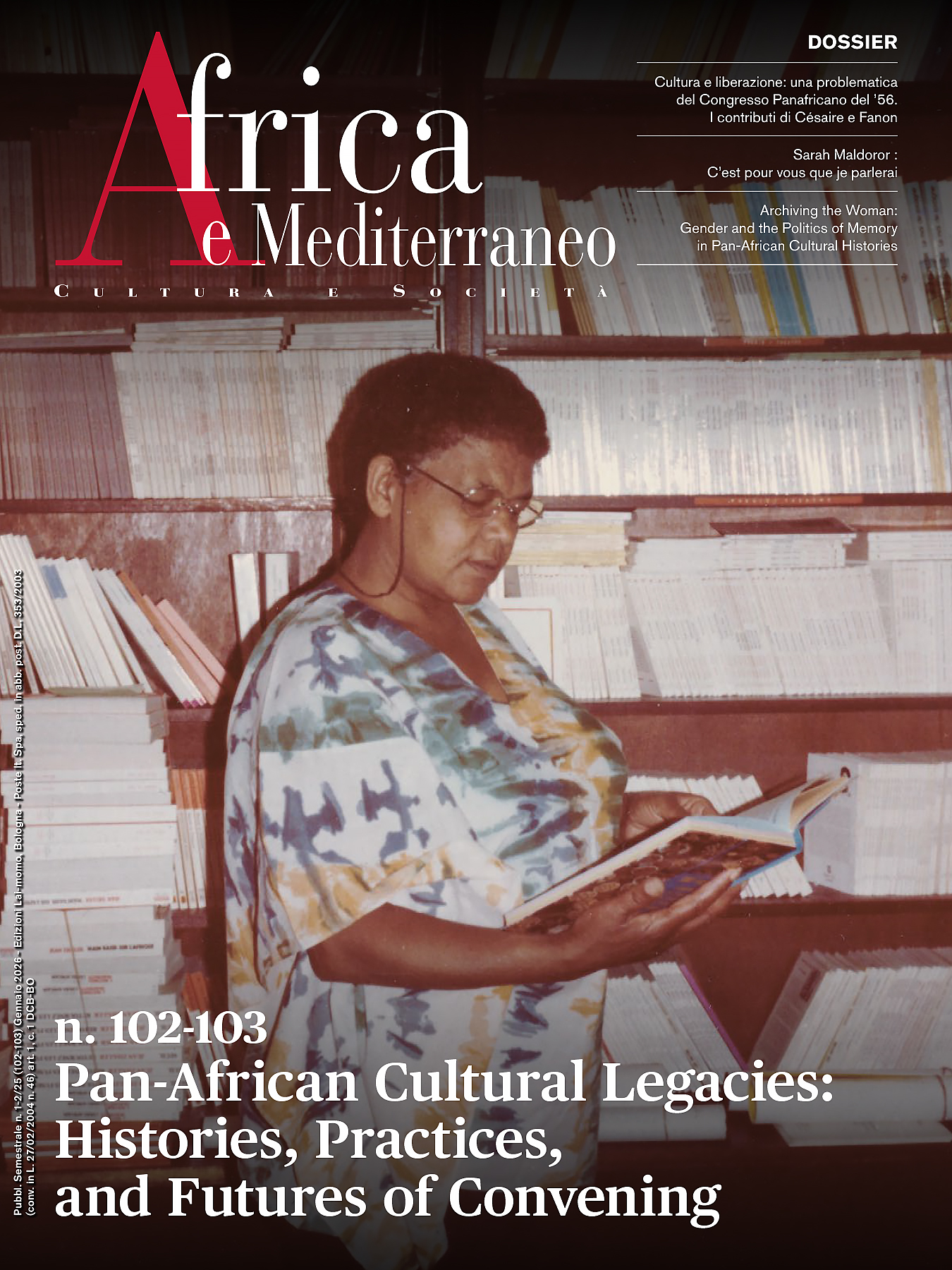
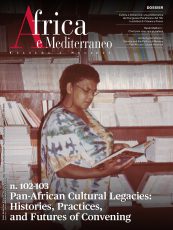
Pan-African Cultural Legacies: Histories, Practices, and Futures of Convening
Africa e Mediterraneo n. 102-103 (2025)
Notes on Convening(s)
by Black History Month Florence
HEY
C’MON
COME OUT
WHEREVER YOU ARE
WE NEED TO HAVE THIS MEETING
AT THIS TREE
AIN’ EVEN BEEN
PLANTED
YET
June Jordan, Calling on All Silent Minorities;
from Directed by Desire: The Complete Poems of June
Jordan (Copper Canyon Press, 2005). Copyright
2005, 2017 by the June Jordan Literary Estate
But what, you may ask, is culture? It is desirable that
this should be defined in order to dissipate certain
misunderstandings and reply very precisely to
certain anxieties that have been expressed by some
of our enemies, and even by some of our friends.
The legitimacy of the Congress has, for example,
been questioned.
It has been said that if a culture must be national,
surely, to speak of Black-African culture is to speak
of an abstraction.
Aime Cesaire, Culture and Colonisation,
Presence Africaine, 1956
The history and legacy of Pan-Africanism is often narrated through moments of political declaration: manifestos, independence speeches, resolutions, and the emergence of nation-states. Running alongside – and often preceding – these moments, however, is another history, less easily monumentalized and often elusive to the archive; a history of gatherings. Congresses, festivals, schools, editorial platforms, and informal assemblies have functioned as crucial sites where Pan-African ideas were tested, negotiated, expanded upon, and made operational.
The First and Second Congresses of Black Writers and Artists, held in Paris in 1956 and Rome in 1959, marked decisive moments within this trajectory. For the first time, artists, writers, philosophers, and historians were placed at the center of debates on Black internationalism and liberation. While initially grounded in social and political mobilization, these gatherings gradually expanded to encompass a parallel theorization of culture and its role within liberation and anti-colonial struggles.
Criticality was not left at the door, as evidenced by texts ranging from James Baldwin’s Princes and Powers (Présence Africaine 1957) to William Demby’s unpublished From the Campidoglio to the Zoo (1959). These crucial interventions, among a myriad of others, exposed a set of unresolved tensions that continue to shape Pan-African thought today.
From early traces in the work of W. E. B. Du Bois and George Padmore onward, Pan-African convenings adapted their forms, objectives, and vocabularies in response to changing political conditions. Nonetheless, what passes into the archive remains partial and fragmentary. The strategies, organizational methodologies, and practical blueprints that sustained these gatherings are frequently absent or elusively veiled. Yet, it is precisely these coordinated efforts that hold invaluable potential for inspiring and expanding contemporary practices of collective convening.
What survives most vividly are conference reports and published proceedings; from Présence Africaine to Black periodicals such as The Crisis, offering insight into the official speeches, resolutions, and ideological frameworks articulated at these meetings. These documents and pamphlets are essential for reconstructing the stated objectives and public arguments advanced through Pan-African congresses. These official articulations rarely capture the full texture of exchange and recreation that animated these gatherings. That texture emerges more vividly in rare audiovisual records, such as Sarah Maldoror’s filmic documentation of the Négritude Conference held in Miami in 1987, or Paulin Soumanou Vieyra’s footage of the Second Congress of Black Writers and Artists in Rome in 1959. These works make perceptible the informal encounters, shared intimacies, and affective dimensions that shaped the intellectual and political life of these convenings.
Convening as Cultural Infrastructure
To convene is to do more than assemble bodies in a shared space. It is to establish a framework of intelligibility; to determine who may speak, what forms of knowledge are recognized, and how collective meaning is produced. In this sense, congresses and festivals planted the seeds for futurity. They orchestrated and
gave form, words and meaning to discourse, but also produced collectively conjured visibility, circulation, and memory.
The debates surrounding the legitimacy of the 1956 and 1959 congresses reveal how fraught this work was from the outset. Critics questioned whether a “Black” or “African” culture could be meaningfully articulated beyond the nation-state, dismissing such efforts as abstraction. Yet for figures such as Aimé Césaire and Frantz Fanon, who brought to these contexts inward-looking meditations on the legacy of colonialism and the responsibilities of culture itself, abstraction was not the central concern (see Cannelli’s article). As Mahougnon Sinsin points out in his contribution, the more pressing question revolved around whether culture could function as a historical and political process, capable of articulating shared, systematically enforced conditions without erasing the value of specificity and difference. These congresses did not set out to prove an already existing unity; they evoked, designed and implemented a provisional structure within which unity could be debated, contested, and reformulated.
Several contributions in this issue revisit these early congresses to foreground the geopolitical and ideological frictions that shaped them. The fragmented and incomplete architectures that they posited, along with the way-making that they were a part of, indicate how incomplete structures can offer space for imaginings and perceptions needed for these forms of long-term commitment to culture. They advance a revaluing of the radical within what was birthed through these encounters, while keeping romanticizations and sweeping generalizations from claiming and redacting fundamentally under-acknowledged emergent narrations.
Pedagogies and Postcolonial Institutions
If congresses provided temporary spaces for encounter, postcolonial institutions offered more sustained frameworks for cultural experimentation. The transformation of the École des Beaux-Arts de Casablanca in the 1960s exemplifies how pedagogy became a central arena for Pan-African and decolonial thinking. Under the direction of Farid Belkahia, and through the teaching practices of Mohamed Melehi and Mohammed Chabâa, the school rejected Eurocentric modernist canons in favor of genealogies rooted in vernacular, transregional, and popular visual cultures. As Morad Montazami’s contribution demonstrates, this was not an inward-looking project. The Casablanca Art School functioned as a node within a broader constellation of non-aligned, Pan-Arab, and Pan-African networks. Its exhibitions, murals, posters, and publications circulated beyond Morocco, engaging with debates on abstraction, modernity, and political commitment across Africa and the diaspora. In this sense, education operated as a sustained site of gathering, one that extended beyond discrete events to shape long-term cultural infrastructures.
Festivals and Cultural Diplomacy
Large-scale cultural festivals such as the Pan-African Cultural Festival held in Algiers in 1969 (PANAF’69) brought the logic of convening into a different register (see Turchetti’s and Colliva’s articles). Supported by newly independent states and embedded within “Third World” internationalist politics, these festivals sought to materialize Pan-African solidarity on a mass scale. They assembled artists, musicians, writers, and liberation movements, transforming cities into temporary stages for cultural diplomacy.
Performances, exhibitions, and political presence unfolded simultaneously across urban space, collapsing distinctions between cultural program, political gathering, and international visibility. These initiatives also dramatically increased participation, expanding beyond the elite intellectual circles of Europe that characterized previous generations and placing locals as central actors and viewers.
Archives, Silences, and Feminist Re-Mappings
One of the most significant interventions of this issue lies in its sustained engagement with questions of archival absence and historiographic bias. Pan-African archives are approached here through what they fail to record. The uneven visibility of women’s labor and leadership, often read as marginal participation, is in fact an index of how historical value has been assigned and preserved.
Through feminist and womanist lenses, culture appears in the form of governance, enacted through care, pedagogy, kinship, and collective survival strategies. Figures such as Efua Sutherland, Miriam Makeba, Margaret Ekpo, and Nike Davies-Okundaye emerge as institutional actors who built Pan-African infrastructures through theater, music, organizing, and material production (see Asha Salim’s contribution). Their work complicates masculinist narratives that equate political agency with formal leadership and statecraft.
Mistura Allison’s reimagining of the archive through Yorùbá oríkì offers a particularly generative methodological intervention. By naming the archive as ìyá ìrántí, the mother of memory, the text foregrounds relationality, labor, and affect as constitutive elements of historical transmission. Such approaches challenge recuperative impulses that seek to “add” women back into existing narratives without transforming the epistemic structures that produced their exclusion.
The French-language contribution on Pan-African feminist solidarities further extends this argument by situating women’s collective action within contemporary debates on reparative justice (Alkassoum, Almoctar, Geraci, Casale).
Poetics, Land, and Cinematic Witness
While many Pan-African gatherings have been documented through texts and institutional records, cinema and poetry offer alternative modes of transmission. The writings included in this dossier on Sarah Maldoror’s films dedicated to Aimé Césaire draw attention to landscape and voice as political witnesses. In these works, land is an active participant in historical narration, bearing the traces of colonial violence and resistance.
Maldoror’s films frame, cut and layer the environmentally geo-specific atmospheres as evocative of the contradictions of the Antillean condition that Césaire so forcefully articulated. Land, language, and struggle remain inseparable, opening another dimension of convening: cultural forms capable of gathering viewers across time, producing affective and sensorial connections that extend beyond the moment of encounter.
Historiography and National Frictions
The question of scale, continental versus national, returns with particular force in Sakiko Nakao’s examination of the Encyclopaedia Africana and the competing congresses of African historians in the 1960s and 1970s. Conceived as a Pan-African project supported by W. E. B. Du Bois and Kwame Nkrumah, the Encyclopaedia was gradually absorbed into the ideological and institutional apparatus of the Ghanaian state. This shift exemplifies the difficulty of sustaining continental ambitions within the political realities of newly independent nations. The rivalries between historians’ congresses in Accra, Dar es Salaam, Dakar, and Yaoundé further illustrate how Pan-African intellectual life was shaped by national interests and geopolitical competition.
Sankofian Futures of Convening
Altogether, the contributions to this issue argue for an understanding of Pan-Africanism as an unfinished practice, one aspirationally realistic yet speculative, consistently dependent on cultural labor, institutional experimentation, and critical self-reflection. Convening is positioned as a recurring strategy for addressing conditions of fragmentation, displacement, and political urgency.
Contemporary initiatives for Black convening, whether in physical or digital spaces, continue to draw upon these legacies. They do so selectively, often implicitly, adapting past methodologies to new contexts shaped by globalization, technological mediation, and renewed demands for reparative justice. What persists is the recognition that culture remains a primary site for assembling collective futures.
This double issue of Africa e Mediterraneo is not to be intended as a template, to be simply replicated and followed; it engages these questions by interrogating the artistic, ideological, and spatial imaginaries mobilized at the First and Second Congresses of Black Writers and Artists (Paris 1956; Rome 1959), alongside subsequent and parallel initiatives. It offers a set of situated analyses that invite readers to consider the form, function, and implications of past gatherings, attending both to moments understood as success and to those shaped by misgivings, hesitation, or tentative steps that wavered. In doing so, it affirms Pan-African cultural legacies as resources, as tools capable of producing other tools for thinking and practicing, as gatherings around trees that have yet to be planted.
Cover: Sarah Maldoror at the Présence Africaine library, Paris © Clarisse Zimra Images courtesy of Association Friends of Sarah Maldoror & Mário de Andrade.
Africa e Mediterraneo n. 102-103 (1-2/25); Lingua: Contiene articoli in italiano inglese e francese; Codice ISSN: 1121-8495; Formato: 120 pp., 21×28 cm, brossura filo refe.